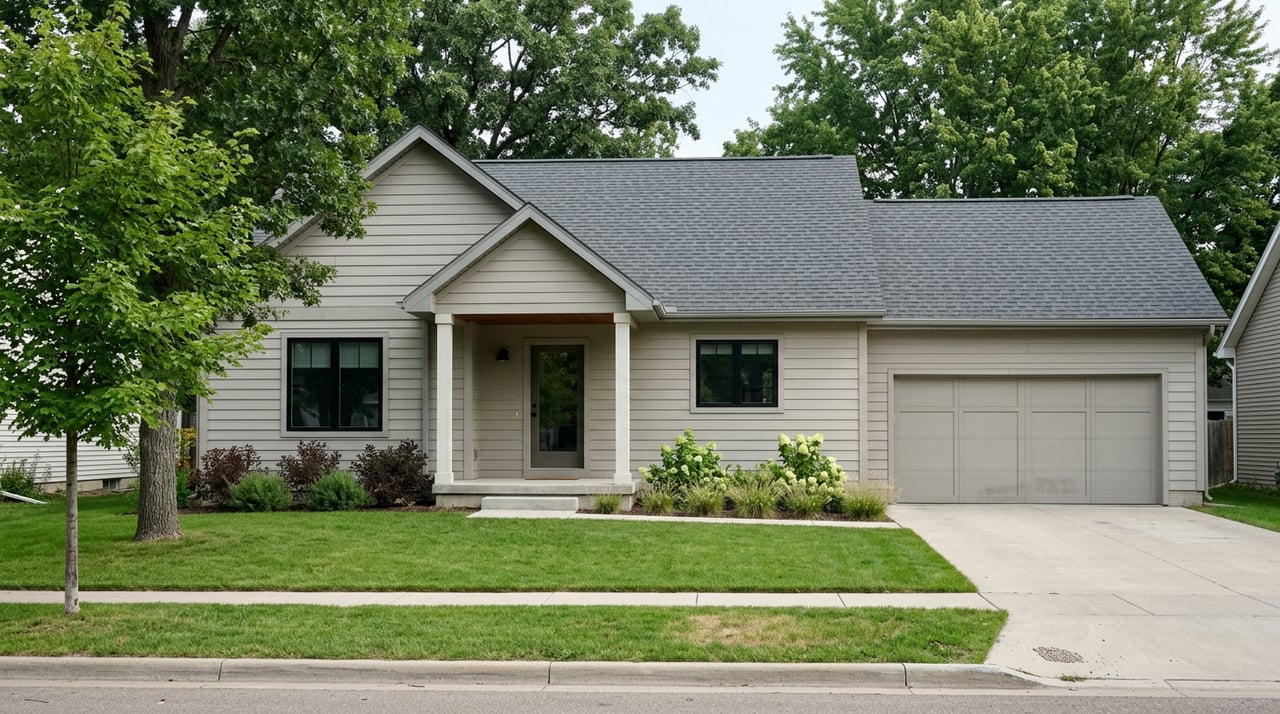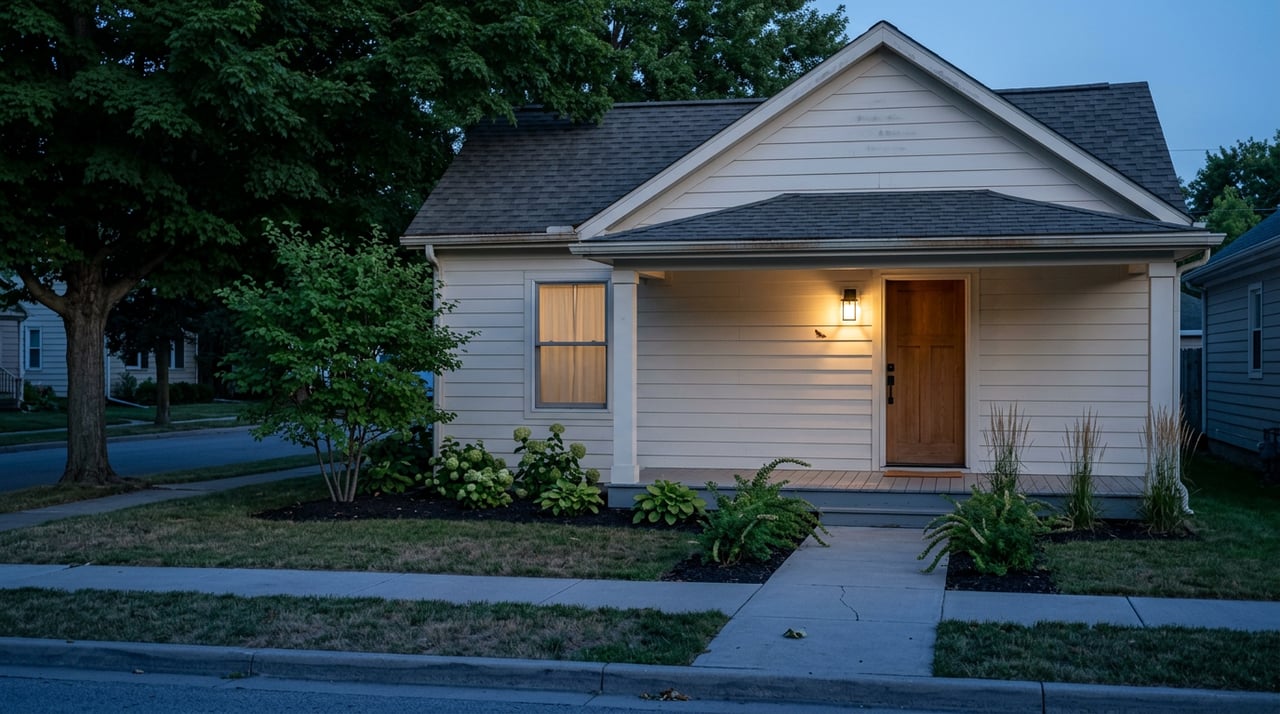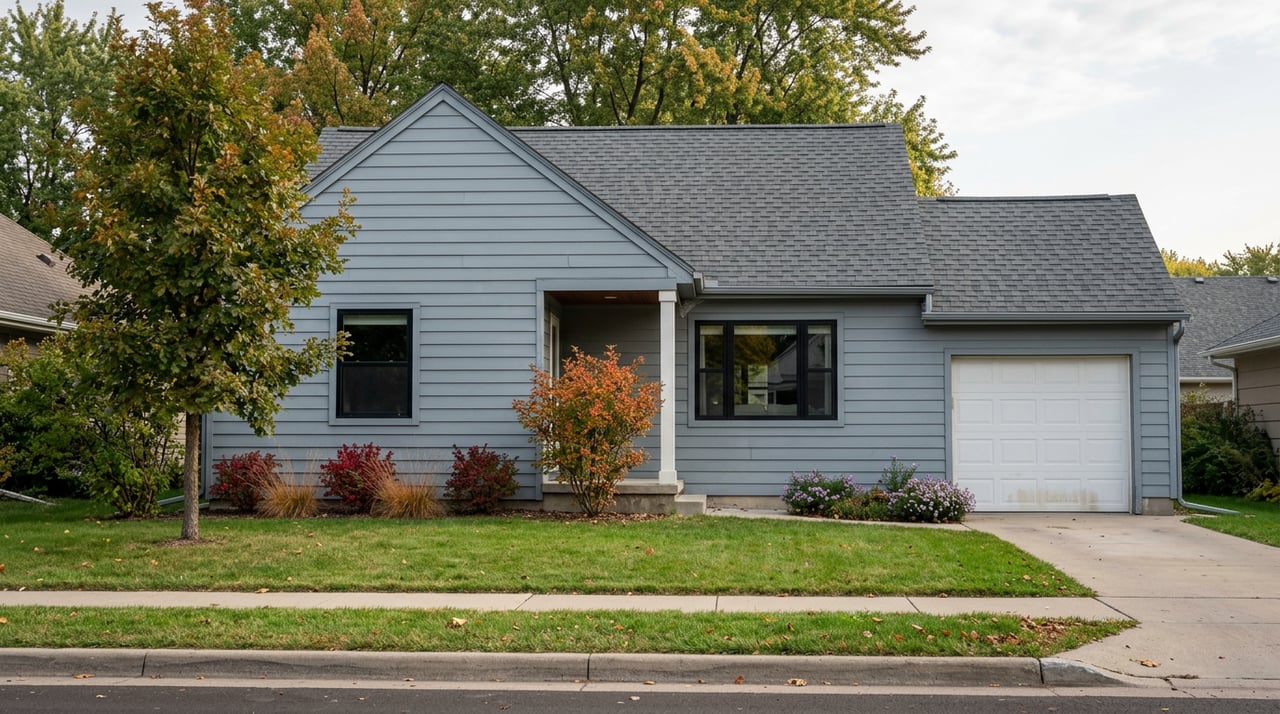
Pull up two pages on the same national brokerage's website for homes in Rushford, Minnesota, and you'll find two different numbers claiming to be the same thing. One page lists the median home value in Rushford at $189,900. Click through to a nearly identical page on the same site, and the median home value in Rushford is $475,000. Same brokerage. Same town. A difference of $285,100.
If you're comparing Rushford against Lanesboro, Chatfield, Preston or Harmony while you plan a move to southeast Minnesota, that kind of gap should stop you cold. It's not a typo you can wave off. It's a symptom of something every small-town home shopper eventually runs into: in a market this size, the "median price" you see on a portal isn't really a market signal. It's noise dressed up as data.
The Number That Can't Sit Still
Look at what happened to Rushford's own reported median listing price over three consecutive months in 2026, all pulled from the same aggregator:
| Month (2026) | Median List Price | Price per Sq Ft | Median Days on Market |
|---|---|---|---|
| April | $249,000 | $147 | 45 |
| June | $322,000 | $147 | 45 |
| July | $232,000 | $132 | 20 |
That's a $90,000 swing from the high point to the low point, inside a single quarter, from a single source. Days on market bounced too, from 45 down to 20 and back up. If you were tracking this the way you'd track a stock chart, you'd think Rushford's housing market was having a small nervous breakdown. It isn't. What's actually happening is much simpler and much more useful to understand before you make an offer.
A separate flat-fee listing platform reports Rushford's average sold price at $217,400, then in the very same write-up calculates price per square foot two different ways, landing on $71 per square foot in one sentence and $256 per square foot in the next, for what's supposed to be the same set of homes. Two other brokerage sites list Rushford's average active price at $287,450 and $302,568. One of those averages is built from a pool of two active listings. The other comes from nineteen.
That's the actual mechanism at work: Rushford is a town of roughly 1,876 people. A handful of closings in any given month can swing a "median" or "average" by tens of thousands of dollars, because there simply isn't enough volume to smooth out the outliers. Sell one $475,000 farmhouse on a big parcel and one $150,000 starter home in the same reporting window, and depending on how a site chooses its date range and which listings it counts, you can get numbers that look like they belong to two different towns.
The County Tells the Same Story, Louder
Zoom out to Fillmore County and the pattern gets even more obvious. County-wide data showed a median sale price of $215,000 in December 2025, reported as a 59.3% increase year over year, on a total of just 15 homes sold that month, up from 13 the year before. A 59% jump on 15 transactions isn't a housing boom. It's what happens when a couple of higher-priced sales land in a short window against a small comparison base. A separate county pull for spring 2026 put the median at $326,022, up 14.4% year over year, a very different number describing the very same county in the very same season.
Go back to an August 2024 county report and you'll find the same fingerprint: four-bedroom homes down 14.5% year over year while five-plus bedroom homes were down nearly 50%, in the same month the county's overall median price was reported as rising. Those aren't contradictory trends. They're the same small sample size cutting the data into slices too thin to mean anything on their own, and the pattern hasn't changed in the two years since.
A Second Layer of Confusion: Two Towns, One Name
There's a wrinkle specific to Rushford that makes all of this even easier to get wrong if you're shopping from out of town. The City of Rushford is completely surrounded by a separate incorporated city called Rushford Village, a 33-square-mile township of rolling farmland, small manufacturing and home-based businesses that wraps around both Rushford and the neighboring city of Peterson. Depending on how a listing site draws its boundary for "Rushford," a search can quietly include or exclude farmland parcels in the surrounding township, township-zoned acreage sales, or entirely different school and tax jurisdictions. That's a second axis of noise stacked on top of the small-sample problem, and it's exactly the kind of local detail a scraped national database has no way to sort out.
What's Actually Worth Tracking Right Now
If the scraped medians are unreliable, what should a buyer or seller comparing Rushford to other Driftless-area towns actually look at? A few things that are happening on the ground carry more signal than any single portal number.
The Rushford Area Historical Society reopened its Historic Depot Museum on June 9, 2026, after a renovation funded by a $254,953 Legacy Amendment grant from the Minnesota Historical Society, awarded in January 2024. The project, led by architect Todd Grover of MacDonald & Mack Architects and contractor Cody Johnson of Norse Valley Construction, uncovered rotting sill beams that had simply been laid on bare sand when the building went up in 1867, a problem made worse over the decades by flooding. RAHS secretary Sally Ryman has described the depot's role connecting generations of local families as the museum reopened. A community investing that kind of grant money and volunteer hours into its trailhead landmark tells you more about long-term confidence in a downtown than any single month's median price.
Rushford's Economic Development Authority runs an annual self-guided "Open Doors" tour of available commercial spaces, pairing prospective buyers with EDA staff and gap financing options. The current downtown business opportunities list includes a historic limestone building ready for a restaurant, a roughly 8,500-square-foot former retail building on Highway 43, and a four-plex with three apartments and 1,000 square feet of retail space listed at $298,000 after a $30,000 price reduction. One longtime downtown fixture, run first as a bakery and later as a restaurant and bar for more than 15 years, is now on the market for the next owner. That's a real, current snapshot of what commercial square footage costs in downtown Rushford, and it's a lot more useful to an investor than an averaged residential number.
Meanwhile, the former Farmers Win Cooperative site west of Highway 43 went through a City of Rushford Village public hearing on July 7, 2026 for a conditional use permit covering an agricultural warehousing and distribution facility, including fill placement in the floodplain, a sign that industrial and ag-adjacent land use in the township is actively moving forward. That same site has also been floated to the community as a potential redevelopment opportunity through EDA-run public input sessions.
On the land side, Fillmore County's broader Driftless bluff country shows an average land listing price around $769,778 across roughly 24-acre parcels, working out to a median of about $24,791 per acre. But that average blends wildly different products. It might describe a 24.97-acre parcel along the Houston-Fillmore county line with a quarter mile of Root River frontage and direct access to the Root River State Bike Trail, or it might describe an 87-acre tillable farm with 130 acres of hardwood timber overlooking the Yucatan Valley, priced for its deer hunting potential. Those aren't the same asset class even though they get folded into the same countywide average.
How To Actually Read A Small-Town Market
None of this means Rushford's data is useless. It means the single-number summary is the wrong tool for a market this size. A better approach:
- Ask for the actual number of closed sales behind any median you're shown, not just active listings.
- Track price per square foot across a rolling several-month window instead of trusting a single month's snapshot.
- Separate residential comps from land and commercial comps. They move on different clocks and different logic entirely.
- Confirm whether a listing's "Rushford" boundary includes Rushford Village township parcels, since tax jurisdiction and zoning can differ meaningfully from in-city lots.
- Weigh what's actually happening locally, like commercial turnover, civic investment and permit activity, alongside the price data rather than instead of it.
That last point is really the whole argument. A median price pulled from a scraper doesn't know about the four-plex on Mill Street, the depot's rotted sill beams, or the difference between a river-frontage recreational parcel and a tillable row-crop farm. A local agent tracking actual closed transactions does.
FAQ
So what is Rushford's real median home price right now? Honestly, no single number does the market justice. Recent data points across sources have ranged from roughly $217,000 to $322,000 depending on the month and the method. The more useful question is what's closed in the last 60 to 90 days that's genuinely comparable to what you're buying or selling, which is a conversation worth having directly rather than settling from a portal snapshot.
Why does Rushford Village show up separately from Rushford in some searches? Rushford Village is its own incorporated city that surrounds both Rushford and Peterson. It has its own city council, its own EDA, and its own permitting process, so a search boundary drawn around "Rushford" may or may not include Village-zoned land depending on the site.
Is land pricing in the area more stable than home pricing? Not really more stable, just differently volatile. Land prices depend heavily on what the parcel is used for, whether that's river frontage, tillable acreage, or hunting ground, so averages across very different land types can be just as misleading as home price averages.
If you're weighing Rushford against another southeast Minnesota town and want the real comp pull instead of a scraped average, that's exactly the kind of groundwork John Nelson does before pricing a listing or writing an offer. Schedule your free market consultation and get numbers you can actually use.